Practice Smarter, Not Harder
Webinar
4 min read
How do I improve my practice sessions?
How do I learn and memorize pieces faster?
How do I maximize my time and plan out practice sessions?
These are some of the questions I’ve heard countless times from students. You are not alone, ‘cause let’s face it, practicing the piano can be really boring. We’ve all been there. I used to ask these questions too when I was younger.
Working with great professors, my teaching and performing experiences helped me find the answers to these questions. But, it took me years to achieve it. Let me tell you something, it doesn’t have to be this way.
That’s why I feel such an urge to pass on the knowledge and strategies on how to practice more effectively. Make tiny changes, and see big differences.
If you are looking for answers to these questions, this blog post is definitely for you. Even though it can be a great challenge to overcome these issues, try applying strategies from this blog post and your game will change instantly.
So, without further ado, let’s dive in.
Strategy no. 1
ANALYZE THE CHORDS
When trying to learn a new piece, try to simplify it as much as possible. Think in terms of chords and try to figure out the basic harmonies. Play the chords simultaneously. Remember, everything stems out of chords. Playing all the notes of the chord at the same time can be helpful if you are trying to learn to play some broken chord progressions or arpeggio, for instance.
Strategy no. 2
NOTICE PATTERNS
Try to notice all sorts of patterns there are in a piece. If there are octaves in the right-hand part, memorize that. If there are sequences, try to memorize those as well. Even if you are a beginner, no worries, work with what you know. Look at most basic shapes like scales, intervals, or if some sections are repeating.
Strategy no. 3
MEMORIZE THE FINGERING
Let’s say you are trying to learn some difficult arpeggio. Apart from analyzing it harmonically, you can try memorizing the fingering as well. When you prioritize learning the fingering, it’s going to help you fix it in your mind visually, so you’ll feel much more confident while playing it.
Strategy no. 4
MEMORIZE THE ARTICULATION AND DYNAMICS
If you prioritize memorizing articulation and dynamics - believe it or not - it’s gonna help you learn to play a piece by heart much faster. Think of it as learning some story. It’s more likely you are gonna learn it if it’s told expressively, right? Simply look at it like you are grasping the emotion behind the piece. You are telling a story expressively, just in the language of music!
Strategy no. 5
MEMORIZE VISUALLY
There are a lot of chords in the piece? Focus on their position and their shape. Observe how your hand looks while you are playing a certain chord and visually memorize those positions and shapes of the hand. You can apply the same strategy if there are intervals in the piece.
Strategy no. 6
NOTICE DIRECTION OF THE MELODY
Observe the melody and direction of it. Is it an ascending, or descending melody? Learn the direction of it, it’s gonna help you map out the piece.
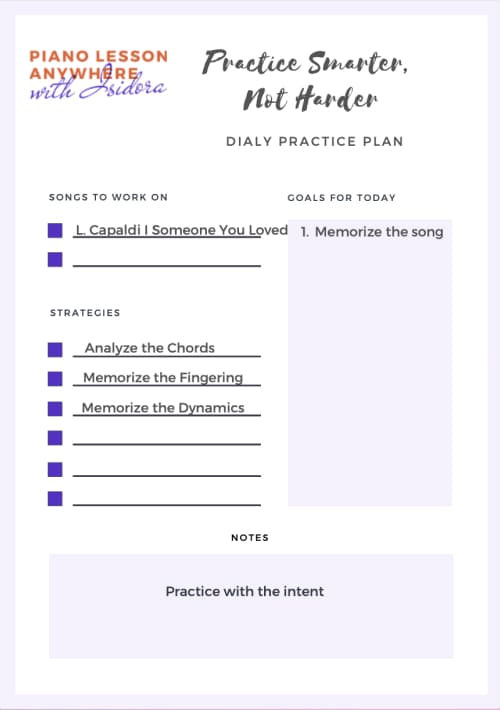
All these strategies boil down to one thing - they are supposed to help you map out the piece in as many different ways as possible. Once you make a blueprint of a piece in your mind, you’ll learn to play it by heart in no time. And on top of it, your practice sessions will be more structured. You don’t have to use all the strategies at once - you can use only one or two - and then use the next two in some other practice session. Hope you will feel inspired to come up with your strategies. Just immerse yourself in music, and carefully observe it.
Free content
Download template and create practice plan
If you’d like some help, and see how these strategies could be used in specific situations and pieces, you can watch my webinar called Practice Smarter, Not Harder. Besides these strategies, I will be showing and explaining many more tips and tricks on how to make your practice sessions more effective and fun! Join me and let’s discuss different ways on how to improve your practice sessions